
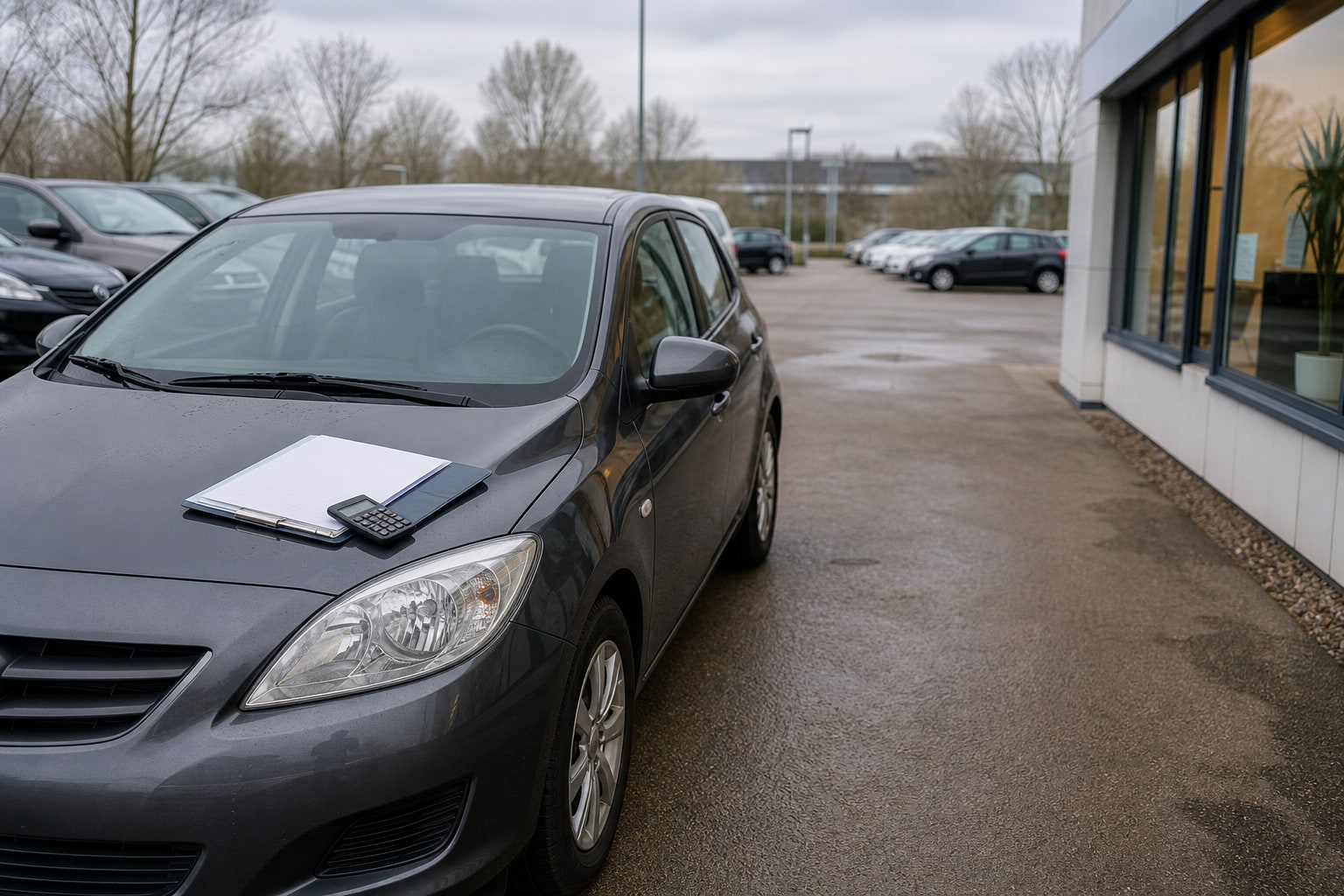
A lender can approve you without a conventional credit score, but the decision will depend more heavily on your income, debts, down payment, co-signer and the vehicle itself. You will be able to identify realistic approval routes, compare the true cost of each offer and avoid financing a car or contract you cannot afford.
Key takeaways
- Show stable income, bank statements, and a manageable debt-to-income ratio.
- Choose a lender and vehicle that accept limited credit history.
- Compare interest, fees, down payment, and total repayment—not only the EMI.
- Ask why you were denied before applying with a co-signer.
No credit history is different from a record of missed payments
A lender can approve a used car loan without credit history when your other evidence shows you can repay. No usable score is not the same as missed payments: a thin file provides little data, while delinquencies provide negative data.
A newly opened account may not create a FICO score immediately; FICO generally requires an account open for at least six months that has reported recently.
Approval odds usually improve when you:
- Make a larger down payment.
- Choose a less expensive vehicle.
- Apply with a co-signer or joint applicant.
- Show stable employment and documented income.
- Provide housing history and details of existing debt obligations.
These factors do not guarantee approval or a low interest rate. The vehicle itself can decide the result: age, mileage, title status, condition, book value, and loan-to-value limits can disqualify an older car even when your income is sufficient.
Before signing, arrange an independent inspection, verify the title and recall status, and compare the loan’s total repayment with the car’s cash price. Approval does not prove that the vehicle is sound or fairly priced.
Buy-here-pay-here financing is another option, but ask in writing whether on-time payments reach the major credit bureaus. Also check whether the contract allows a starter-interrupt device and requires payment directly at the dealership.
What improves approval when your credit file is thin
For loan approval with limited credit history, improve both your application and the lender’s security. A larger down payment, a cheaper vehicle, a co-signer or joint applicant, and stable, documented income address the main concerns. None guarantees approval or a low interest rate.
| Change | Why it helps | Best use |
|---|---|---|
| Larger down payment | Lowers the amount borrowed and the loan-to-value ratio | When savings allow you to pay more upfront |
| Less expensive car | Reduces the monthly payment and lender’s potential loss | When the original vehicle is too costly |
| Co-signer or joint applicant | Adds another person’s income and credit record | When that person accepts shared repayment responsibility |
| Shorter loan amount or term | Limits the lender’s exposure | When the payment still fits your budget |
For a used car loan with limited credit history, the vehicle itself can decide the result. Ask about maximum age, mileage, title status, condition, book value and loan-to-value limits before applying; an older or high-mileage car can be rejected even when your income qualifies.
Prepare recent pay stubs, bank statements, proof of residence and identification. If you are self-employed, provide tax returns, and ask which income sources the lender accepts. Unverifiable income is a warning sign, not an advantage.
Before signing, obtain an independent inspection, verify the title and recall status, and compare the loan’s total repayment with the car’s cash price. Approval confirms financing, not mechanical quality or fair pricing.
The car itself can decide whether the loan works
A lender can decline a borrower with suitable income because the car is the collateral. Age, mileage, accident damage, title problems, low book value, or a high loan-to-value ratio can make the vehicle difficult to repossess and resell. A loan for thin credit history still has to make sense against the car’s value.
Before buying, check these points in order:
- Arrange an independent inspection. Ask for a written report covering the engine, transmission, frame, brakes, tyres, airbags, leaks and diagnostic fault codes. A lender’s approval does not prove the car is mechanically sound.
- Verify the vehicle identification number, title, registration history and outstanding lien with the relevant government record. Reject a car with a salvage, flood, rebuilt or unclear title unless you understand how that affects insurance and resale.
- Check open safety recalls using the manufacturer’s recall database or an official government portal. Ask who will pay for any unrepaired recall work.
- Compare the lender’s maximum age, mileage, book-value and loan-to-value rules with this specific car. An older car can fail the lender’s policy even when your income qualifies.
- Compare the cash price with the amount financed and total of payments. Include the APR, finance charge, required insurance, late fees, prepayment terms and add-ons such as GAP coverage or a service contract.
If declined, ask whether the reason was the vehicle, income, debt-to-income ratio, credit history or missing documents. That answer tells you whether to change the car or the application.
Compare the full financing cost, not a low monthly payment
Compare the cash price and the loan’s total repayment, not the monthly payment alone. A longer term can make an expensive loan look affordable while adding thousands in interest.
| Option | Compare before signing | Risk to check |
|---|---|---|
| Bank or credit union | APR, finance charge, amount financed and total of payments | The quote may exclude dealer add-ons |
| Dealer-arranged loan | The same figures, plus the cash price negotiated separately | Dealer markup above the lender’s buy rate |
| Buy-here-pay-here | APR, total payments, payment location and late fees | The dealer may not report on-time payments and may require a starter-interrupt device |
Get an outside bank or credit-union quote before discussing dealer financing. Compare both offers using the same vehicle price, down payment and loan term; otherwise, a lower payment can hide a higher price or longer repayment period.
These are vehicle loan options for poor credit, but “no credit check” does not mean low-cost or risk-free financing.
Ask for the contract’s insurance requirements, prepayment terms and every add-on, including a service contract, GAP coverage and credit insurance. Have an independent mechanic inspect the car, then verify the title and recall status; approval proves neither mechanical condition nor fair pricing.
If the figures do not match, Loaniva can help you organise competing vehicle-loan offers before you sign.
What to do after a denial or before using a co-signer
After a denial, ask the lender for the specific reason before submitting another application. In the United States, an adverse-action notice usually identifies the main reason for denial or the credit information used.
1. Match the fix to the reason. If income or debt-to-income ratio caused the denial, document stable earnings and pay down an existing obligation. If the vehicle was too old or expensive for the lender, choose a cheaper car or make a larger down payment.
2. Prepare a complete file. Gather recent pay stubs, bank statements, proof of address, employment details, identification, and records of rent or utility payments. Missing documents can make a lender reject an application that otherwise fits its criteria.
3. Compare offers in one short shopping period. Ask whether each quote uses a soft or hard credit inquiry, then submit applications close together. Scoring models often group same-type auto-loan inquiries, but the time window differs.
4. Check the car before accepting approval. Pay for an independent inspection, verify the title and recall status, and compare the total loan repayment with the vehicle’s cash price. Approval does not prove the car is sound or fairly priced.
A co-signer accepts legal responsibility for the full debt if you do not pay. A missed payment can damage both credit records, so the co-signer should read every disclosure, confirm the total repayment obligation, and understand that approval does not guarantee a low interest rate.
Frequently asked questions
Can you get a used car loan without credit history?
Yes. A lender can consider income, employment, bank statements, existing repayment records, down payment, and the vehicle’s value when no usable credit score exists.
Is no credit history the same as poor credit?
No. A thin file lacks enough borrowing data, while poor credit reflects negative information such as missed or late payments.
What improves approval for a used car loan with limited credit history?
Provide proof of stable income, reduce existing debt, make a larger down payment, choose an affordable vehicle, and add a co-signer only after understanding the liability.
What should you compare besides the monthly payment?
Compare the interest rate, processing and documentation fees, insurance requirements, down payment, loan term, prepayment charges, and total repayment.
Keywords