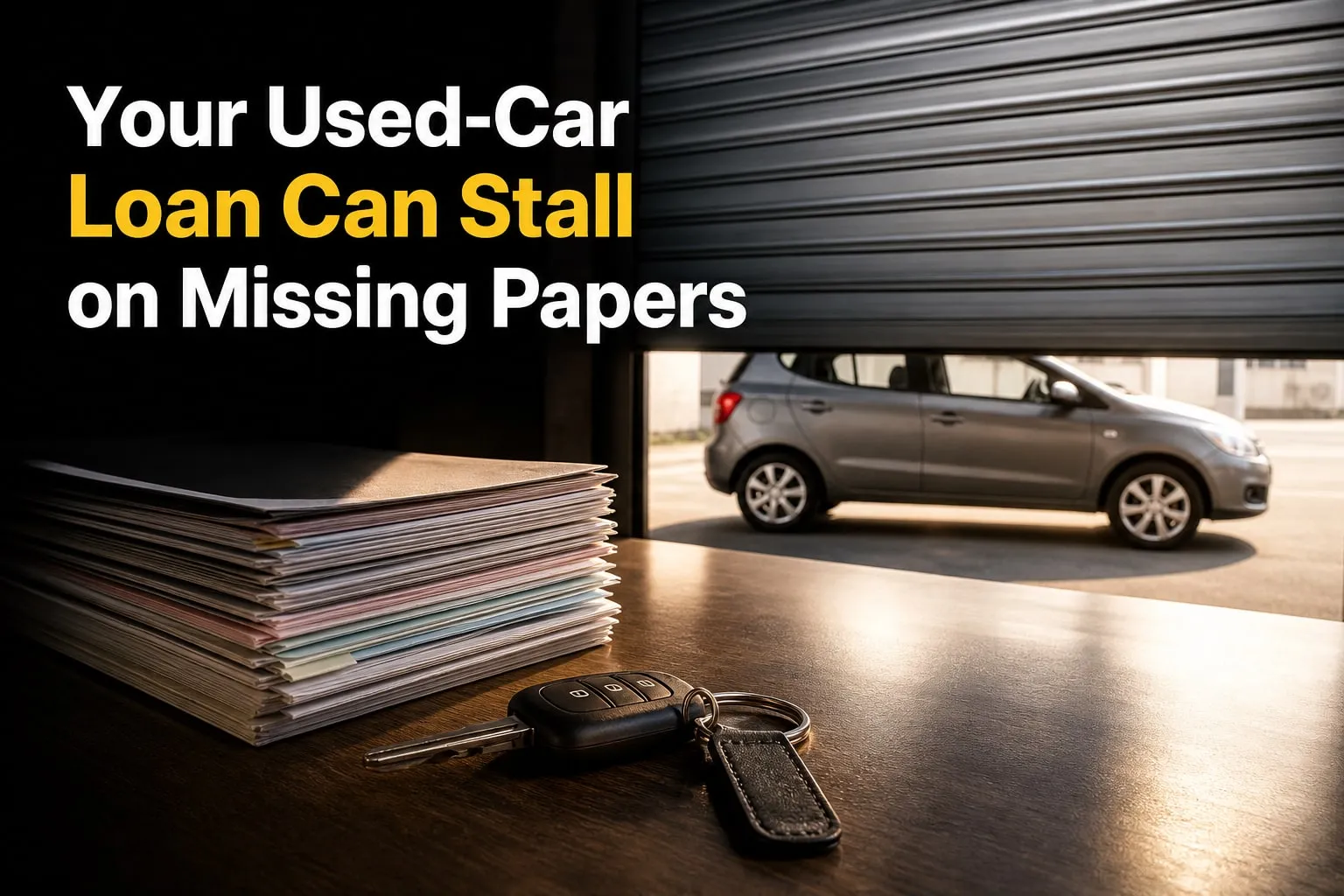
A lender needs two files before funding: your identity and repayment documents, plus proof that the seller owns the car and can transfer it. By sorting each document by borrower, seller, vehicle, and lender verification, you can find gaps before they delay approval or disbursement.
Key takeaways
- Keep PAN, address proof, bank statements and income records ready.
- Ask for the seller’s registration certificate, insurance and Form 29 and Form 30.
- Check whether the seller is a dealer, private owner or financier.
- Match every name, address, registration number and loan detail before submission.
Which borrower documents should you prepare first?
Your used car loan required documents start with a signed loan application form and a consistent identity file. Prepare:
- PAN card, Aadhaar or another accepted government photo ID
- Current address proof, such as a recent utility bill, bank statement, insurance statement or registered lease
- Passport-size photographs
- Date of birth, employment details and phone, email and emergency contact information
- Salary slips or other income proof
- Recent bank statements
| Applicant type | Income records to prepare | Typical period |
|---|---|---|
| Salaried | Salary slips, Form 16 where available and bank statements | Latest two or three salary slips; three to six months of statements |
| Self-employed or business owner | Form 16 where available, income-tax returns, computation of income, business registration or GST records, profit-and-loss statements and bank statements | Last two or three years of returns; six to twelve months of statements |
| Pension, rental, commission or other income | Pension or benefit statements, lease records, commission records and bank credits | Recent statements covering the income received |
Check that your name and address match across the PAN card, Aadhaar, bank statements, salary slips and application. If a name differs, submit a name-change certificate or marriage certificate and ask the lender to update its records; for a new address, provide a recent utility bill or registered lease and ask which document takes priority.
A co-borrower or co-signer submits substantially the same identity, address, employment and income records. A co-signer can be legally responsible for the unpaid balance, not merely listed as a reference.
What must the seller and vehicle file contain?
Used car loan seller documentation falls into two files: records proving who is selling the car and records proving what is being financed.
| Record type | Documents to collect | What to check |
|---|---|---|
| Seller records | Government identity proof, address proof, bank details for payment, ownership proof, and a signed sale agreement or purchase invoice | Seller’s name and address match the ownership records and contract |
| Vehicle records | Original Registration Certificate, valid insurance, current pollution-under-control certificate, Form 29, Form 30, and any financier’s loan-closure letter or NOC | Registration number, VIN, owner name, engine number and chassis number match the vehicle and documents |
| Supporting vehicle records | Odometer disclosure where required, service history, inspection report, and maintenance records | Details are consistent and satisfy the lender’s review |
Inspect the original RC, not only a photograph. Compare the VIN stamped on the vehicle with the RC, sale agreement, and loan paperwork, then check for salvage, rebuilt, flood, or other title brands; these marks can affect approval, resale value, and insurance.
A registration card, insurance card, or service receipt does not replace clear, transferable ownership. An unsigned title, missing odometer entry, mismatched VIN, or unreleased lien can stop funding even after you submit every personal document. Ask for the financier’s NOC or verified payoff evidence when the RC shows hypothecation.
These checks form the core of the used car loan documents required from a private seller and vehicle file. Ensure the seller signs every transfer document before the lender issues payment.
How do documents change by seller and financing route?
The used car loan documents required depend on who sells the vehicle and how you finance it. Confirm the exact channel with the lender before paying a deposit.
Dealer-arranged finance uses the dealer’s contract and vehicle file. Direct bank or credit-union finance may require a purchase order before issuing a draft. Private-party auto finance adds ownership and seller checks, while an unsecured personal loan can avoid vehicle-title documents but does not normally create a lien on the car.
| Option | Paperwork and security | Key consequence |
|---|---|---|
| Dealer-arranged finance | Buyer’s order, purchase agreement, or retail instalment contract; lender records the vehicle lien | Dealer submits the final contract |
| Direct bank or credit-union finance | Purchase order before the lender issues a draft; title and VIN checks | Draft amount must match the final transaction |
| Private-party auto finance | Signed sale paperwork, assigned title, seller verification, lien checks | Funding waits for clear ownership |
| Unsecured personal loan | Loan agreement, without vehicle-title documents or a car lien | Rate, term, and borrowing limit differ |
For a dealer, require a contract showing the VIN, selling price, taxes, fees, trade-in credit, down payment, and final financed amount. An informal quotation lacks the binding transaction details needed for disbursement.
For a private seller, obtain:
- Signed bill of sale, correctly assigned original title, and seller verification
- Odometer disclosure where required, plus lien-release or payoff documents
- Payment instructions identifying the recipient and approved payment method
An online marketplace listing proves neither ownership nor a clear title. The lender still needs the seller’s identity, title, RC, VIN, and signed sale paperwork; confirm who handles inspection and secure payment.
What does the lender verify before approving and funding?
A complete set of used car loan required documents does not guarantee approval. The lender verifies your credit profile, income, employment, housing payment, address, and bank activity before deciding whether you can repay the loan.
| Check | What the lender verifies | Possible result |
|---|---|---|
| Applicant | Credit history, salary or income, employment, address, housing payment, bank activity | Approval, more proof, or rejection |
| Vehicle | Make, model, trim, manufacturing year, registration year, mileage, VIN, title status, valuation | Lower valuation, reduced amount, or ineligibility |
| Transaction | Seller’s asking price, proposed loan, down payment, loan-to-value ratio, down-payment receipt | Larger upfront payment or revised loan |
| Insurance and trade-in | Policy names the financed car and meets required coverage; trade-in title, registration, and payoff documents are complete | Funding held until liens and ownership are confirmed |
Vehicle age and mileage limits can reduce the eligible tenure or financed amount, require a larger down payment, or make the car ineligible. Required insurance can exceed compulsory liability cover.
Preapproval based on an estimated price is not final approval. Final funding follows income, VIN, title, purchase-price, insurance, and lien checks.
- Names or addresses do not match.
- Salary slips or statements are expired.
- The VIN differs across documents.
- The price breakdown is incomplete.
- The title is incorrectly assigned.
- The PUC is missing.
- An old lien has no NOC.
Loaniva can help compare lender document lists and check whether a private-sale or dealer file is ready before you apply, alongside other used car purchase financing options.
Related product
 | Used Car Loan Loaniva Used Car Loan helps individuals finance the purchase of pre-owned cars with affordable interest rates, flexible repayment options, and a... View product → |
How can you submit the file without avoidable delays?
Start by asking the lender for its current used car loan documents required checklist; requirements change by lender and financing route. Scan every page clearly, keep originals of the title and registration certificate (RC) for inspection, and confirm that every document is signed, dated, unexpired, and legible.
- Create four folders: borrower identity and address; income and banking; seller and ownership; vehicle and insurance.
- Match the name, address, VIN, registration number, sale price, down payment, and financed amount across the application, sale agreement, RC, insurance policy, and payment instructions.
- Resolve differences before submission: update an address, attach a name-change record, obtain the seller’s lien-release letter, correct Form 29 or Form 30, or replace an incomplete invoice.
- Add proof of the down payment and retain the payment receipt. Do not send a deposit or accept a promise to clear an existing loan until ownership and lien-release arrangements are documented.
Final check:
- Borrower supplies identity, address, income, banking, application, and down-payment records.
- Seller supplies ownership proof, signed sale documents, title or RC, lien-release paperwork, and payment details.
- Lender independently verifies income, VIN, title, insurance, final sale price, and amount financed.
Submit one complete scan set in folder order, then keep the originals and submission receipt.
Frequently asked questions
Which borrower documents are needed for a used car loan?
Prepare the signed loan application, PAN, identity and address proof, photographs, bank statements and income documents. Salaried applicants may need salary slips and Form 16; self-employed applicants may need income-tax returns and business or bank records.
What seller and vehicle documents are required for used car financing?
Collect the vehicle registration certificate, valid insurance, pollution-under-control certificate, seller’s identity proof, and signed transfer forms such as Form 29 and Form 30. Ask for the loan closure letter and Form 35 when the vehicle has an existing hypothecation.
Do documents change for a dealer, private seller or refinance application?
Yes. Dealers add an invoice, dealership and bank details; private sellers provide ownership and transfer records. A refinance or balance-transfer file also needs the existing lender’s loan statement, foreclosure letter and hypothecation-release documents.
What does the lender verify before approving and funding the loan?
The lender checks your identity, address, income, credit history and repayment capacity, then verifies vehicle ownership, registration, insurance, valuation, age and any outstanding hypothecation before disbursing funds.
Keywords