A lender does not base a used-car loan on the seller’s asking price alone. You will be able to follow the valuation from the first VIN and document submission through inspection, lender-approved value, loan-to-value calculation, and the down payment needed to complete the purchase.
Key takeaways
- Submit the registration certificate, insurance, sale agreement, and vehicle details.
- Check the odometer, accident repairs, service history, tyres, and engine condition.
- The lender bases financing on assessed value, not only the seller’s asking price.
- A lower valuation increases your down payment or reduces the loan amount.
What information starts the vehicle valuation?
The valuation starts when the buyer or seller submits the car’s identity, condition, and sale documents to the lender. These used car loan valuation requirements let the lender confirm which vehicle will secure the loan before arranging an inspection.
1. The seller provides the registration number, VIN, engine number, odometer reading, year, make, model, trim, engine, drivetrain, mileage, location, and title status. The buyer adds the purchase order or bill of sale, proposed price, and financing details.
2. The lender usually requests the registration certificate (RC), insurance policy, service records, seller and buyer identification, and ownership history. If the seller still owes money, obtain a lien-release or payoff statement showing the outstanding loan and the lender’s release process.
3. The lender compares the submitted details with its valuation guide, internal model, comparable transactions, and purchase paperwork. There is no single legally mandated lending value, so the recognised value may be lower than the seller’s asking price or negotiated price.
4. After document review, the lender assigns an authorised or empanelled vehicle assessor. The assessor checks the VIN on the vehicle against the RC or title, registration record, insurance documents, and sale paperwork, then arranges the physical inspection.
Private-party purchases receive closer document review because they lack a dealer invoice and dealer warranty record. The lender may request extra ownership, title, lien-release, service, or inspection records before accepting the car as collateral.
What does the assessor inspect on the car?
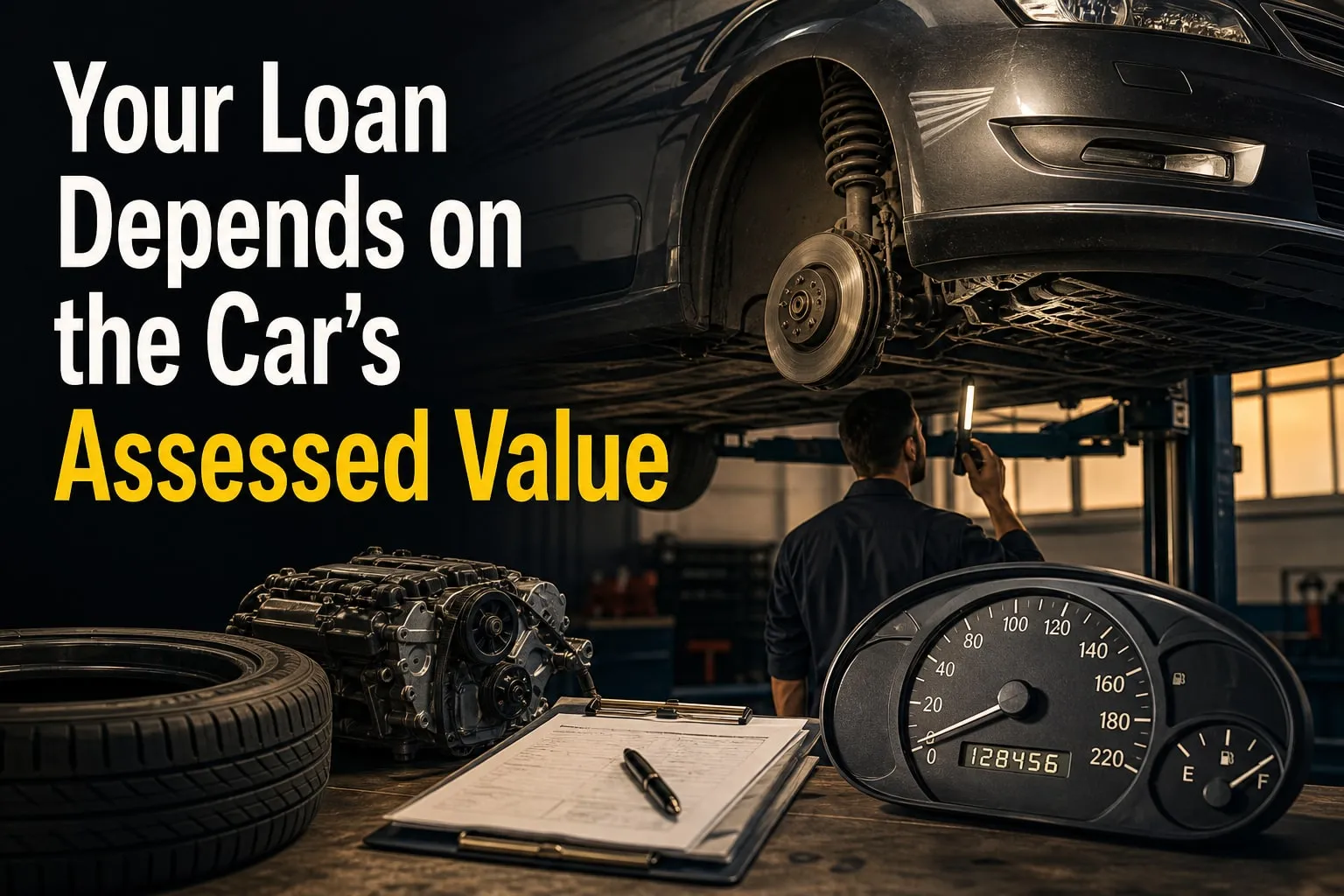
The assessor first records the car’s make, model, trim or variant, manufacturing year, registration year, engine, drivetrain, odometer reading, fuel type, ownership count, and vehicle location. These details form the core used car loan valuation requirements; a wrong trim or missing option can change the recognised value.
1. Confirm identity: match the VIN, engine number, registration number, and registration certificate with the title and sale documents. Record mismatches rather than treating them as clerical errors.
2. Check the exterior: inspect paint colour and finish, body-panel alignment, dents, rust, glass, mirrors, lights, tyres, and wheel damage. Uneven paint or panel gaps can indicate accident repairs.
3. Inspect structure and cabin: look beneath the car for chassis or frame damage, then check the interior, seat belts, dashboard warnings, water marks, mould, and signs of flood or fire damage.
4. Assess mechanical condition: examine the engine, transmission, suspension, steering, brakes, exhaust, leaks, and other visible mechanical parts. A road test or start-up check can reveal noises, vibration, smoke, slipping, or warning lights.
5. Reconcile records: compare the odometer with service invoices, inspection readings, and vehicle-history information. Check the title and history report for salvage, rebuilt, flood, lemon-law, or another branded title.
A history report cannot replace an independent mechanical inspection because unreported accidents and repairs may never enter insurer, police, or vehicle-agency databases. The lender can require repairs, reduce recognised value, set a lower loan-to-value limit, or reject the car when resale as collateral would be difficult.
How does the lender turn inspection findings into a car value?
The used car loan vehicle valuation process turns inspection findings into an approved collateral value by combining the vehicle’s recorded identity, condition, and market evidence. No single legally mandated used-car value exists for lending, so each lender sets its own method.
| Figure | What it means |
|---|---|
| Seller’s asking price | The amount the seller initially requests |
| Negotiated purchase price | The amount buyer and seller agree to document |
| Invoice price | The dealer’s recorded acquisition or sales figure |
| Private-party market value | An estimated price between individual buyers and sellers |
| Trade-in or wholesale value | What a dealer or wholesaler may pay before resale preparation |
| Retail value | A dealer’s expected selling price after reconditioning and overhead |
| Resale value | The amount the vehicle may realise in a future sale |
| Lender-financed value | The lender’s approved collateral value used for loan underwriting |
The lender may use a valuation guide, recent comparable transactions, an internal model, the inspection report, or a combination. Depreciation, manufacturing and registration age, mileage, condition, ownership history, accident or flood damage, location, fuel type, trim, options, demand, and remaining useful life all affect the result.
An incorrect trim or omitted option can materially change the estimate.
The lender then compares the documented purchase price with its approved collateral value and may use the lower figure. That is why the assessed value can fall below the seller’s asking price even when the car looks well maintained. The recognised value also sets the base for loan-to-value: amount financed divided by lender-approved vehicle value.
How does the assessed value change the loan and down payment?
The assessed value sets the ceiling for the vehicle portion of your loan and therefore the minimum down payment. Loan-to-value (LTV) means the amount financed divided by the lender’s recognised vehicle value.
If the lender recognises a car at ₹6,00,000 and approves financing up to 80%, the vehicle portion cannot exceed ₹4,80,000, leaving at least ₹1,20,000 for you before taxes, registration, insurance, documentation fees, add-on products, or other charges.
| Scenario | Calculation | Effect on buyer |
|---|---|---|
| Recognised value ₹6,00,000; 80% LTV | ₹6,00,000 × 80% = ₹4,80,000 | Pay at least ₹1,20,000 toward the vehicle |
| Purchase price ₹5,50,000 | Loan limit remains ₹4,80,000 | Pay at least ₹70,000 toward the vehicle |
| Purchase price ₹6,50,000 | Loan limit remains ₹4,80,000 | Cover at least ₹1,70,000, or negotiate |
Do not assume 80% applies to every lender. Before comparing used car purchase financing options, ask for these figures in writing:
- The lender’s valuation basis: purchase price, wholesale or retail guide value, comparable sales, internal model, or inspection
- The approved LTV percentage and vehicle value
- The maximum vehicle age and mileage rule
- The maximum loan term and the total amount financed
If the price exceeds recognised value, close the gap with a larger down payment, a lower negotiated price, a cheaper car, or another lender. Extending the term lowers the instalment but does not remove the gap.
Loaniva can help compare the valuation basis and financing offers; obtain the approved value and total amount financed in writing.
Related product
 | Used Car Loan Loaniva Used Car Loan helps individuals finance the purchase of pre-owned cars with affordable interest rates, flexible repayment options, and a... View product → |
What can delay or change the final valuation decision?
After inspection, the lender completes used car loan valuation requirements by checking the title or RC, VIN, ownership records, sale document, insurance, and any payoff statement. Collateral approval asks whether the car secures the debt; borrower approval asks whether you can repay it. A car can pass the first decision and fail the second.
- A branded title, unresolved lien, mismatched VIN or RC details, missing ownership documents, or an unpaid seller loan can stop the transaction until corrected.
- Inconsistent odometer records require supporting service or inspection evidence.
- Serious repairs or an incomplete lien release can delay funding even after the vehicle receives a value.
Older or high-mileage vehicles carry greater resale risk. The lender may apply a lower permissible loan-to-value ratio, shorter term, higher rate, or no financing.
Used car purchase financing options differ in cost and control:
| Option | Main comparison | Key caution |
|---|---|---|
| Direct bank or credit-union financing | APR, total repayment, fees, term, prepayment rules | Preapproval gives you a benchmark |
| Dealer-arranged financing | APR, total repayment, fees, term, prepayment rules | A dealer rate markup can raise the cost |
| Private-party vehicle loan | APR, total repayment, fees, term, prepayment rules | Extra title and lien documents can delay funding |
| Unsecured personal loan | APR, total repayment, fees, term, prepayment rules | The loan is not secured by the car |
Taxes, registration, documentation fees, guaranteed asset protection, service contracts, credit insurance, and trade-in negative equity can increase the balance without increasing collateral value. Income, debt-to-income ratio, credit history, employment, down payment, and term limits still determine final approval.
Frequently asked questions
What information starts the used car loan vehicle valuation process?
The lender starts with the car’s registration certificate, make and model, registration year, variant, odometer reading, insurance policy, sale agreement, and seller details. These documents identify the vehicle and support an inspection request.
What does a vehicle assessor inspect on a used car?
The assessor checks the vehicle identity, exterior panels, paint, accident repairs, chassis, engine, transmission, suspension, tyres, interior, electrical systems, odometer, service records, and roadworthiness.
How does a lender convert inspection findings into a car value?
The lender compares the car’s age, variant, mileage, condition, service history, local market prices, and inspection report. Existing damage, missing records, or an altered odometer lowers the assessed value.
How does the assessed value affect the loan and down payment?
The lender applies its financing limit to the assessed value. If that value is below the sale price, you must pay the difference along with any required down payment, or choose a lower loan amount.
What can delay or change the final vehicle valuation decision?
Missing registration or insurance documents, an unavailable seller, an unclear chassis number, inconsistent mileage, unresolved hypothecation, poor condition, accident damage, and an incomplete inspection can delay or change the decision.
Keywords