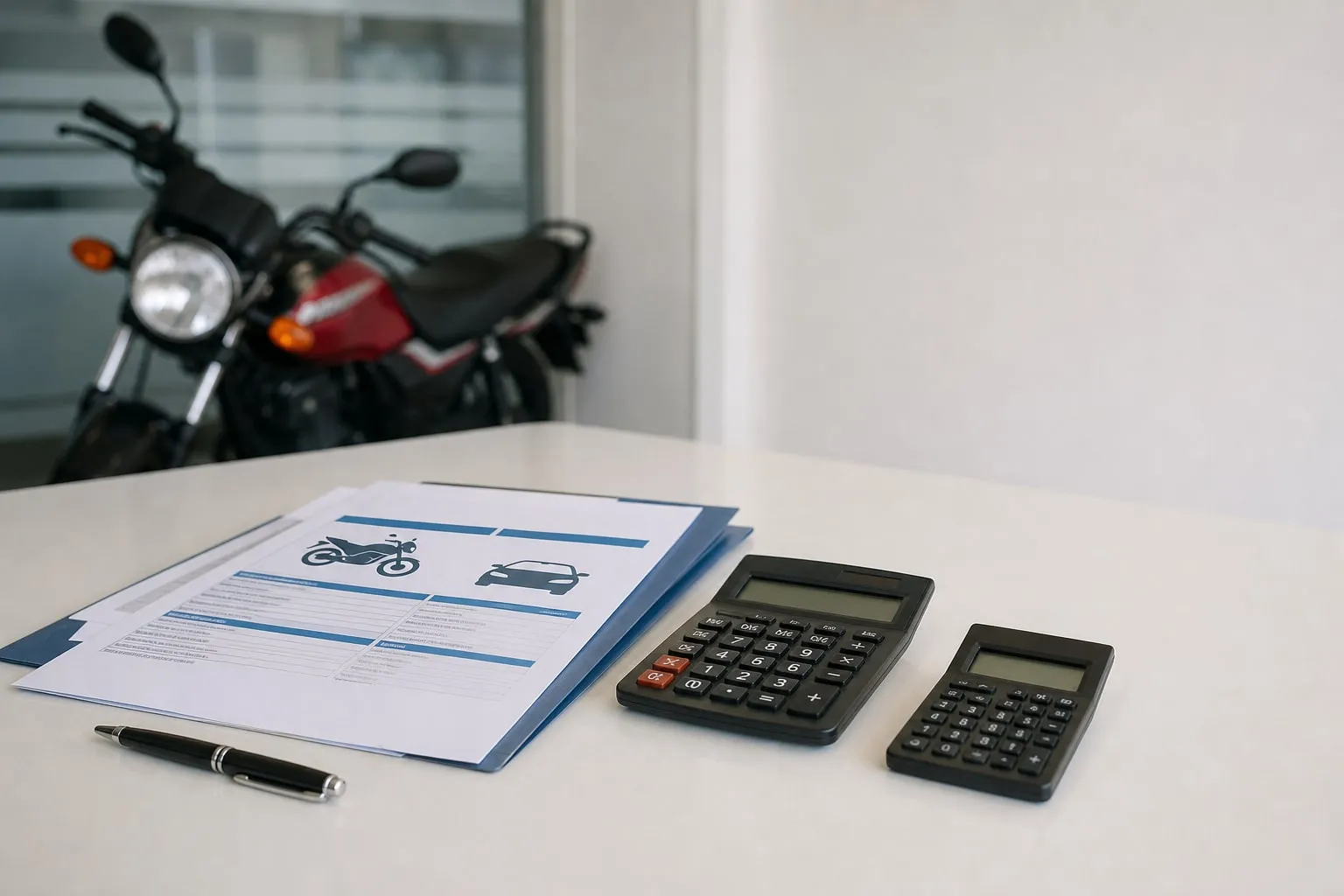
A lender’s advertised percentage does not reveal the full cost of borrowing: the rate may be flat or reducing-balance, while fees, add-on financing and prepayment terms can change the result. By the end, you will be able to compare written offers using the same loan amount and tenure, verify an estimate, and choose an instalment that fits your documented cash flow.
Key takeaways
- Confirm whether each lender quotes a flat or reducing-balance rate.
- Compare APR, processing fees and total repayment—not the headline percentage alone.
- Request a written, like-for-like offer with tenure, EMI and every charge listed.
- Match your income proof and credit history to the requested EMI.
Compare the rate method before comparing the percentage
Identify the rate method before starting a two wheeler loan interest rate comparison. A flat rate applies the quoted percentage to the original principal for the entire tenure; a reducing-balance rate applies it to the unpaid principal, which falls after each EMI. The same percentage therefore does not mean the same cost.
| Rate method | How interest is calculated | Example on ₹100,000 for 36 months at 10% |
|---|---|---|
| Flat rate | 10% of the original principal each year | ₹30,000 interest before fees |
| Reducing balance | 10% annual rate on the declining principal | EMI about ₹3,227; total interest about ₹16,200 |
Compare offers only after matching the principal, down payment, tenure, repayment frequency, and rate method. Then check the APR, total amount repayable, processing fee, documentation or convenience charge, insurance or add-on financing, late-payment charge, and foreclosure or part-prepayment fee.
A ₹1,000 processing fee affects a small loan more sharply than a large one, and it can outweigh a slightly lower rate.
Record the vehicle’s cash price, financed amount, and every promotion separately. Dealer subvention or cashback can reduce the net cost without changing the lender’s headline rate, while comparing monthly EMI alone can hide a longer tenure or higher total repayment.
Treat a two wheeler loan interest rate estimate as provisional. Credit history, existing obligations, income stability, down payment, tenure, vehicle model and age, location, and lender policy can change the sanctioned offer.
For loans covered by the Reserve Bank of India’s Key Facts Statement rules, use the KFS to verify the APR-style annualised cost and third-party charges before signing.
Use APR and total repayment to expose the real cost
Use the APR and total amount repayable, not the advertised percentage, for a two wheeler loan interest rate comparison. Start with the exact amount financed: it may include the motorcycle price plus registration charges, insurance, accessories, or other approved costs. A larger loan increases both the EMI and total interest.
| Cost or loan detail | Include from both offers | Why it matters |
|---|---|---|
| APR | Annualised cost shown in the Key Facts Statement | Captures interest and disclosed lender charges in one yearly figure |
| Amount financed | Principal after adding approved extras | A higher principal raises repayment even at the same APR |
| Total amount repayable | All EMIs plus fees payable over the full tenure | Shows the rupee cost of choosing a longer or costlier loan |
| Processing, documentation and convenience fees | Amount, timing and whether GST is added | A ₹1,000 fee has a bigger impact on a small loan |
| Insurance and add-on financing | Premiums, accessories and bundled products included in the loan | You pay interest on these additions too |
| Late-payment charges | Per-event fee, penal interest and applicable taxes | One missed EMI can change the comparison |
| Foreclosure and part-prepayment fees | Percentage, minimum amount and lock-in period | These affect your cost if you repay early |
For loans covered by the Reserve Bank of India’s Key Facts Statement rules, check the KFS before signing. Confirm that third-party charges collected through the lender are separately disclosed, then match the KFS APR, financed amount and total repayment against the sanction letter.
A low processing fee does not rescue an offer with expensive add-ons or foreclosure charges.
Treat the rate estimate as a starting point, not an approval
A two wheeler loan interest rate estimate shows the price a lender may offer from the details you provide, such as income, credit profile, vehicle and requested tenure. It helps you shortlist lenders, but it is not a sanction, a binding offer, or proof that your application will pass.
Before signing, use this procedure:
- Ask what assumptions produced the estimate. Confirm the loan amount, down payment, tenure, vehicle model and location recorded by the lender.
- Check your credit report and existing EMIs. Missed payments, a lower credit score, or high unsecured debt can raise the final rate or reduce the approved amount.
- Provide current proof of income, identity and address. Unstable or poorly documented income can change the lender’s risk assessment.
- Request the Key Facts Statement before accepting the offer. For covered loans, it should show the final rate, annualised cost measure, repayment schedule and disclosed third-party charges.
- Compare the sanctioned offer, not the advertisement. Include the processing fee, documentation or convenience charge, insurance or add-on financing, late-payment charge and foreclosure or part-prepayment fee.
A larger down payment and an EMI that fits your documented cash flow can strengthen the application. Avoid sending many applications at once; multiple credit enquiries can affect how lenders assess you. A lender can also revise terms after verifying the vehicle’s age, model or eligibility.
Match income proof and credit behaviour to the requested EMI
Match your requested EMI to income you can document, then make application choices that reduce lender risk. A two wheeler loan income proof must agree with your bank credits, employer or business details, loan amount, and existing monthly obligations. Unexplained cash deposits, mismatched records, or unverifiable documents can delay approval.
| Applicant profile | Documents to prepare | EMI and application choice |
|---|---|---|
| Salaried | Recent salary slips, bank statements, employment details | Choose an EMI that fits regular net salary after existing EMIs |
| Self-employed | Income-tax returns, bank statements, business records | Use an EMI supported by stable business cash flow |
| Variable or informal income | Bank-credit history, residence or business evidence | Add a co-applicant or larger down payment if the lender accepts it |
| High existing debt | Current loan statements and repayment records | Reduce unsecured debt before requesting a new EMI |
To improve two wheeler loan approval chances, check your credit report before applying. Dispute incorrect overdue accounts, settle genuine overdue balances, and avoid several loan applications within a short period because each lender’s enquiry can affect how your credit behaviour appears.
- Keep your Aadhaar, PAN, address proof, and employment or business records current.
- Make a larger down payment to reduce the loan amount and EMI.
- Submit complete statements with clear salary or business credits.
- Ask the lender which income documents it accepts before submitting the application.
A co-applicant does not automatically fix weak repayment history, and a larger down payment does not replace accepted income proof. Choose the EMI only after adding existing obligations, rent, insurance, fuel, and routine household costs.
Turn competing offers into a written, like-for-like decision
Before authorising a full loan application, turn every quote into the same written record and compare matched terms.
1. Request a written quote or Key Facts Statement from each shortlisted lender. Check the two wheeler loan interest rate comparison on the same loan amount, tenure, rate method, APR, and repayment schedule.
2. Record the total amount repayable, processing fee, documentation or convenience charge, insurance or add-on financing, late-payment charge, foreclosure fee, and part-prepayment fee. Ask who receives each third-party charge.
3. Ask whether the lender will perform a soft eligibility check or a hard credit enquiry. Use soft checks while narrowing your choices; repeated full applications create multiple enquiries and can make your file look riskier.
4. Compare only offers with the same down payment, vehicle price, tenure, and EMI date. Get the quote’s validity period and every approval condition in writing.
5. Before choosing, reduce high-cost unsecured debt, correct credit-report errors, update identity and address documents, and select an EMI supported by documented cash flow. These steps can improve two wheeler loan approval chances, but they do not guarantee sanction.
Loaniva should present lender responses in this same written format if it assists with your comparison; verbal promises cannot replace the lender’s KFS or sanction terms. Stop and clarify any unexplained fee before submitting documents.
Frequently asked questions
Why must you identify the rate method before comparing two-wheeler loan interest rates?
A flat rate applies interest to the original principal throughout the tenure, while a reducing-balance rate applies it to the unpaid principal. Equal percentages can therefore produce different total costs.
How do APR and total repayment reveal the real cost of a two-wheeler loan?
APR combines the interest cost with eligible loan charges, while total repayment shows the amount you will pay through all EMIs and listed fees. Compare both figures across offers.
Is a two-wheeler loan interest rate estimate an approval?
No. The lender can revise the estimate after checking your income proof, credit history, requested amount, tenure and vehicle details.
What documents and credit behaviour can improve two-wheeler loan approval chances?
Provide consistent income proof, such as salary slips, bank statements or business records, and avoid missed payments, multiple new applications and high outstanding balances before applying.
Keywords